Pulse Building
The Pulse On Time is composed of the rising and falling edge times and the pulse width time. The actual pulse signal is generated using I/Q waveform data and a marker signal to drive the signal generator pulse modulator. The marker signal on time is larger than the I/Q signal on time. The marker signal includes an additional time equal to the edge times of the signal generator pulse modulator. This insures that the pulse modulator is fully on before the IQ data rising edge starts. This combination provides the fastest possible edge times while also providing the highest pulse On/Off ratio.
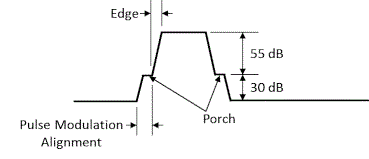
Because the pulse modulator turns on before the I/Q data rising edge and turns off after the I/Q data falling edge there is a slight porch around the pulse. This porch is typically 55 dB down from the pulse. The effects of this porch can be minimized by minimizing I/Q carrier leakage and making sure that the marker signal is properly aligned.
As the minimum pulse width and minimum PRI are reached, the marker signal to the pulse modulator may not have sufficient resolution to represent the individual pulses. In this case the marker signal will remain on until the off time is sufficient to match the marker resolution.
Driving the pulse modulator with the marker signal has the added benefit of preventing the ALC from trying to level the signal when the pulse is off.
The minimum pulse edge times are established by the Arb Sample period and limited by the signal generator hardware. The minimum edge times shown were generated by setting the edge times to 0 ns and have over shoot and ringing. The over shoot and ringing can be minimized by setting the rising and falling edge times equal to about 3 sample periods. For the Arbs with faster sample rates 5 ns is a good edge time to minimize overshoot and ringing.
Minimum edge times are as follows:
|
M9484C VXG |
= 0.333 ns |
The pulse width specifies the time that the pulse amplitude is 100%. The pulse width can be set to 0 seconds. Any pulse, if generated, is a result of the Rising and Falling edge time properties.
Typically, the signal generator will specify a minimum pulse width that can be generated while the ALC is enabled. This is typically 1 to 2 us. It is important to note that it may take hundreds of repetitions of the pulse for the ALC to fully level the output signal. If this is not acceptable, you may disable the ALC. The Pulse Building software will automatically disable the ALC when the pulse widths are less than the signal generator specified minimum.
The theoretical maximum signal on time is limited by the waveform memory and the Arb sample rate. The on time is composed of all of the unique pulses placed in memory. A single pulse may use all of the waveform memory, or the memory may be divided between unique pulses.
On Time maximum = Waveform Segment maximum1 / Sample Rate maximum.
|
M9484C VXG |
= 140 ms |
The maximum pulse width available on a 64 bit system is limited by the maximum array size that can be allocated in .Net. The maximum array size is set by a signed 32 bit integer. It is 231-1 or 2,147,483,648 bytes. Because pulse builder generates complex I/Q data (8 byte real for I and 8 byte real for Q) the maximum array size is 227 -1 or 134,217,727 samples.
For the 64 bit operating system this works out to a maximum pulse width of about:
|
M9484C VXG |
= 330 ms |
(Limited by Arb waveform memory) |
1. The small section of waveform memory filled with zeros used to generate the pulse off time is ignored.